Over the course of our filming, Nikita and I decided to make a video each day to reflect on how it went.
Day one:
Here, we reflected on how time consuming it was to film each shot three times in order or them to be masked. Also, it appeared to be really impractical that Nikita had to keep swapping outfits, but this is something we had to get used to if we wanted the masking shots to be done.
Day two:
The location we chose was not much of a problem, but the overall idea of shooting outside is one that I will not consider in the near future. I initially wanted to film outside because it suited the song and the image of the artist. Moreover, as my AS coursework was shot inside, I wanted to have a different experience when filming to see what challenges I would face and how I would overcome them. Being outdoors was definitely the biggest challenge in this coursework as it was cold and Nikita's outfits were not warm, It was really windy which overpowered the sound of the music and the singing on set and finally the light was constantly changing second by second which made it difficult as the the longer we were outside, the more the shots looked different because of the natural light. We mentioned a variety of shots here that we planned to use and did actually film. However, as we were outdoors and it was very uneven, the shots did not come out as we had hoped and unfortunately they could not be used. This put us as a disadvantage as the most creative shots that we intended to use could not be part of our video, limiting the movement shots we had planned with the dolly.
Day 3:
Having overcome all the negatives and the monotonous process of recording more than once per shot to be masked, I enjoyed the process of masking at the beginning. It was really interesting to use this technique as I was completely out of my comfort zone when preparing for it. I think it was the end product that gave me motivation to record all the extra footage as I knew that by doing something I had never done before, I was improving my skills in media.
Day 4:
It was at this point that we finished our filming and we were so glad that this stage was over, as we were ready to face the challenges of editing together our sequences.
This is the second draft of my music video. Since the first draft, I made various changes before exporting my second draft. However, before I export my final draft, I need to play around with the colour correction, so the footage all looks the same, and also has a warmer feel.
This is the first draft of my music video that I exported. Once I played it outside of Final Cut, I looked to see what needed to be improved. This included re-framing and scaling some of the shots, cutting more sharply to the beat in various places, and also adding in more quick shots and taking out the longer ones. Moreover, I re filmed sections of my base track to include in the next draft.
Considering this blog is all about music videos, I thought I would share one of my favourite videos at the moment. It is important to note that I hate the song, however, I love the video. It is a great example of how important a music video is in terms of selling an artist because if the video was any different, I would not watch it altogether, as I only watch it because of the idea, not the song itself. After researching music videos in depth and working on my own, it is great to see that such a simple idea is so effective. Even though when watching it, the audience is caught up in the concept of the video, it should not go unnoticed the amount of different shots that have been used; 360 degree shot, close ups, bird's eye view, mid shots and profile shots to name but a few.
Whilst using Final Cut to edit my music video, I have learnt a range of new skills from cutting to the beat, colour correcting, making jump cuts and using new effects to name but a few.
This screenshot shows me incorporating an effect onto a piece of footage. The effects ease the transitions between the pieces of footage and deter an abrupt jump from happening.
As seen in other posts, I used the RGB effect to alter the colour of a scene. In the build up shots before this scene appears, each shot resembles one of the colours used, before the final shot with al three colours appears. This random burst of colour is exactly that, random. Although the green links with the colour theme of the digipak, they are the only scenes that have been edited in this way. This links in with the 'gag' aspect of the video as effects, colours and transitions fulfil this type of genre.
This shot shows me working to get this footage in time with the music, essentially, each foot tap would be in sync with the music for the duration of that shot. As you can see, I put the waveform on the audio track to make it easier to visually see the timing of the song, which allowed me to cut to the beat easily.
Moreover, this screenshot shows me cutting each quick shot to the beat. There was a series of shots taken for the 'da lat da' section of the song and each line had a different character. As a result, it was crucial to get each clip in time with the song as they were very quick transitions.
This is showing the process of making jump cuts on the Final Cut timeline. All you do is make a freeze frame of the section of the clip you want, drag it onto the timeline, and then take the other freeze frames from the rest of the video, in sequence. The end product is the freeze frames on the timeline that when played, jump from image to image in an effective way.
This screenshot shows me turning a series of clips into one big effect. Again, this relates back to the gag video, where from my research I saw that over the top, random editing, was a convention of this genre. Each clip comes on in sequence and then the fifth clip comes from the middle and takes over the screen, before the shot changes.
Finally, this screenshot shows me matching two of the trickiest masking shots to the music. Individually, they are about 2-3 seconds each, but took over 5 hours to make, each! However, they look very effective in the sequence and this is one of the effects that I enjoyed the most, as I never realised it was a possibility for my music video.
In addition to masking, other types of editing are present in the music video. This mixture of edits, colour and effects fit appropriately with the theme of the 'gag video' and in a sense, add to the humour and the stupidity. This scene was done by playing with the RGB to make each character a different colour to make the split screen stand out.
Initially, the background was green to fit in with the colour scheme. However I didn't like the outcome and thats when I was introduced to the RGB colours, and that they could be emphasised individually around each character. The black background was then put in to bring together the shot. Lastly, they were made different sizes simply for effect and again, the green one was bigger to emphasise the colour scheme.
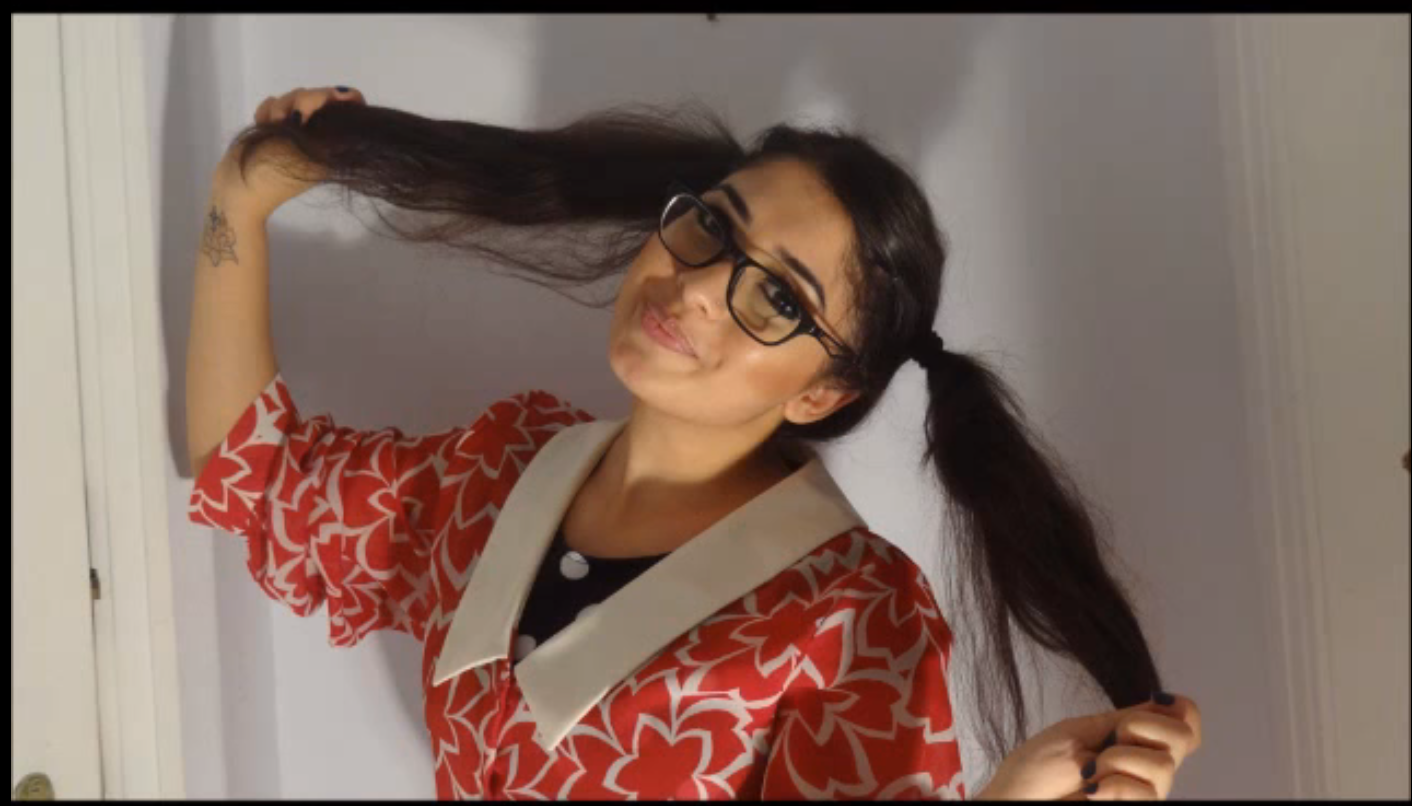
Of all the shots that had to be masked, I found 39 one the hardest because Nikita had to snatch a rose from herself which was tricky as contact was involved between the two masked characters. When filming this shot, I came into the scene and Nikita snatched the rose from my hand. This made it look realistic as she was actually snatching it from someone, instead of pretending to. When it came to editing this shot, I had to mask myself out and mask the slut character in.
This shows the masking around the slut character as I begun to work on the snatching of the rose. At first it was difficult because when the nerd character reached out to steal the rose, it was still visible in the second characters hand.
This shot shows the mask that was made around the nerd character to guide her movement in the actual snatching of the rose. What kept going wrong was the fact that it looked like the nerd character was going through the character of the slut when her hand went in for the rose, so in effect it distorted the footage altogether. What's more, a shadow was cast around the nerd character when she was in motion which emphasised the mask. As a result, two more masks had to be added to the layer.
In order to resolve the issue of the transitory hand and the fact that the rose was still there when the nerd had already snatched it, I had to import that section into Photoshop. Here, I used the Clone Stamp to take a sample of Nikita's skin colour on her neck, and use this to remove the rose, so in effect, it made it look like it had been snatched.
Scenes 59-61 consisted of the characters swapping the instruments. Firstly, the nerd had the tambourine and then in the next shot, the characters on either side of her had it. The next shot then showed the nerd back with the tambourine and the last shot, the other two characters had it again. Also, it proved challenging to get the characters to sing the line in time with each other and, once I had become familiar with the masking, it was this that became the most time consuming part of the editing.
This shot shows the nature character being masked into the shot, where in she and the slut would be playing the tambourine and the nerd would just be singing.
Finally, this shot shows all three characters masked into the shot, with the tambourines in the right place and the singing matched up. I discovered that switching on the waveforms helped a great deal when trying to align the singing as I could visually see when it was out, and which characters needed to be put in time with the others.
As we have Nikita playing multiple characters in our music video, it seemed appropriate to put together a photo-shoot to introduce the three characters involved. The first character is a nerd, the second is a nature girl and the third a slut. In the video, these three characters compete for the affections of Bryce Duncan (our artist). We edited this video on Movie Maker as we did not have any of the software we use in school at home. However, we found it very useful as it allowed us to change the duration of each specific photograph to fit in with the music. After we chose our song; LMFAO's ''Sexy and I Know It'' we realised it was very quick and thought we would use this to our advantage and ensure that the photographs were in time with the music. We chose this song, because like the rest of our project, it is light hearted, funny and not serious what so ever which is what we love.
I have selected some of my favourite shots from the photo-shoot below:
As we do not own the rights to the song '500 Miles' it was crucial that we sent an email to the record label responsible for The Proclaimers which is Universal Music. I have taken a screenshot of this email to attach to my blog, whereby it explains this video will be used for educational purposes only, with no intention of making a profit from it.
'Analyse the following video referencing Goodwin and Vernallis. Particularly focus on gender representation and star image.'
Goodwin stated that a music video is a way for artists to showcase their new identity and development over time. This relates to an artists star image. This is constructed through close up shots of the artist themselves and through them lip syncing in the video. Vernallis commented that the lip syncing is crucial because the purpose of the video is to sell the song, and more importantly advertise the artist.
This screenshot is a clever way of emphasising the lip sync as what else would you show other than the artists lips whilst they are singing the song.
This example of a close up exemplifies Goodwin's theory that music videos act as a platform for artists to reinforce their new image.
This video immediately echoes Vernallis' theory of editing to the beat as is shown in the opening. Here is a clip of the opening of the video that I am referring to:
Moreover, Vernallis commented that the artist in a video is constantly on camera, whilst extras are placed into the background so the focus is on the star. This can bee seen through the way the staging is set up in the performance part of the video.
'
Another aspect of this screenshot to take note of is the fact that Rihanna is in considerably less clothing than the men in the band. This relates back to gender representation as the female in the video is in minimal clothing and acts out some very provocative dance routines. This confirms Mulvey's theory of objectification of women, which can also be seen at the start of the video where she is covered in body paint with not much else on.
This costume is a form of intertextuality as it is originally from Red Hot Chili Pepper's music video for Give It Away:
Moreover, another form of intertextuality in the video is through the guitar performance and costume by Slash, the songwriter and former lead guitarist of hard rock band Guns N' Roses.
This screenshot shows Rihanna in the video dressed up to resemble Slash. Below is the original look worn by Slash himself. Moreover, the guitar is part of the iconography which was another of Goodwin's theories, as it represents the idea of a Rock star. Moreover, it could be argued that Rihanna's tendency to wear little clothing is part of her iconography as an artist.
This shot is an example of Goodwin's theory of 'a relationship between visuals either illustrating, amplifying, or contradicting the lyrics' as she is seen holding the chain whilst singing the lyrics 'Rocking these diamonds, i'm rocking this chain'.
This extreme close up creates an intimate shot for the audience as it is if Rihanna is directly addressing them.
This is a vivid shot that clearly shows voyeurism as she is sexualised through little clothing. Here, she is also objectified but it could be suggested she is objectifying herself as she the one acting in such a manor. This is an important shot when looking at gender representation as it is almost always women with skimpy clothing.
This screenshot is important as it highlights how much Rihanna has changed her star image. Here she is showing tattoos, cut and died hair, and heavy black makeup. Although this fits with the theme of the song 'rock star' this image is continued throughout most of her new material.
In contrast, this shot shows Rihanna in one of her early music videos 'Unfaithful'. Here, she looks very pure, with elegant make up, jewelry and hair. This emphasizes how her star image has drastically changed throughout her career.
What's more, this shot from another early single 'Pon De Replay' draws attention to the fact that Rihanna has always worn little clothing in her music videos, which proves the comment that it is part of her iconography as a female artist in the industry.
Overall, this video demonstrated aspects of Goodwin and Vernallis' theories whilst confirming that the representation and star image of an artist are crucial aspects of a music video.
The gratification theory is essentially what the audience are getting out of the video. This approach focuses on why people use particular media. This theory originated in the 1970's/1980's from a Functionalist perspective. It presents the use of media in terms of the gratification of social or psychological needs.
My video would fall under the category of 'entertainment' as the audience would watch it to gain a sense of escapism, relaxation, filling time and allowing emotional release. Through the use of gratification model, the audience become active and use the text instead of being used by the text. As a result, the power lies with the audience and not the producer.
I am happy with the fact that my music video is something that will provide the audience with escapism, especially for my target audience. This is because people of that age (16-23) will be dealing with exams, work, relationship and maturity difficulties and stress. Thus they can reach out to our music video and enjoy what it is offering to them.
Whilst researching existing music videos, I cam across a variety of versions that students like myself have made.
This video was very simplistic, however unlike other video's I have seen for this song, it experimented with different costumes. It was interesting to see what they did with, this as I am planning to use an array of costumes in a humorous way.
This video is another example of a simplistic idea, with a sense of humour in it. However, they do not lip sync throughout and other than the chorus, the lip sync is not up to scratch,
This video demonstrates Goodwin's theory of amplification, in which the performances matches the meaning of the song. They have taken the lyrics very literally and act out whatever is being said. This is something that I have planned to incorporate into my video but I am not making the whole video literal like they have done, as I found it got a bit monotonous. Also, they reused footage which added to the monotony of the video, this has emphasised to me that I need to film enough footage and even a base layer which they do not seem to have done. By watching this it has confirmed to me what I need to do for my own video.
This video was simple and I think that is it's best quality. Although, having said that, they clearly made a base layer which they used for the chorus. I need to make sure I make a base layer to fill parts of my video to mix it up from the other footage.
By commenting on these videos, it has become clear to me that a humorous video is a common occurrence for this song.
Andrew Goodwin highlights five key aspects of music videos that the audience should look out for. These are:
Thought beats (seeing the sound)
Narrative and performance
The star image
Relations of visuals to song
Technical aspects of music video
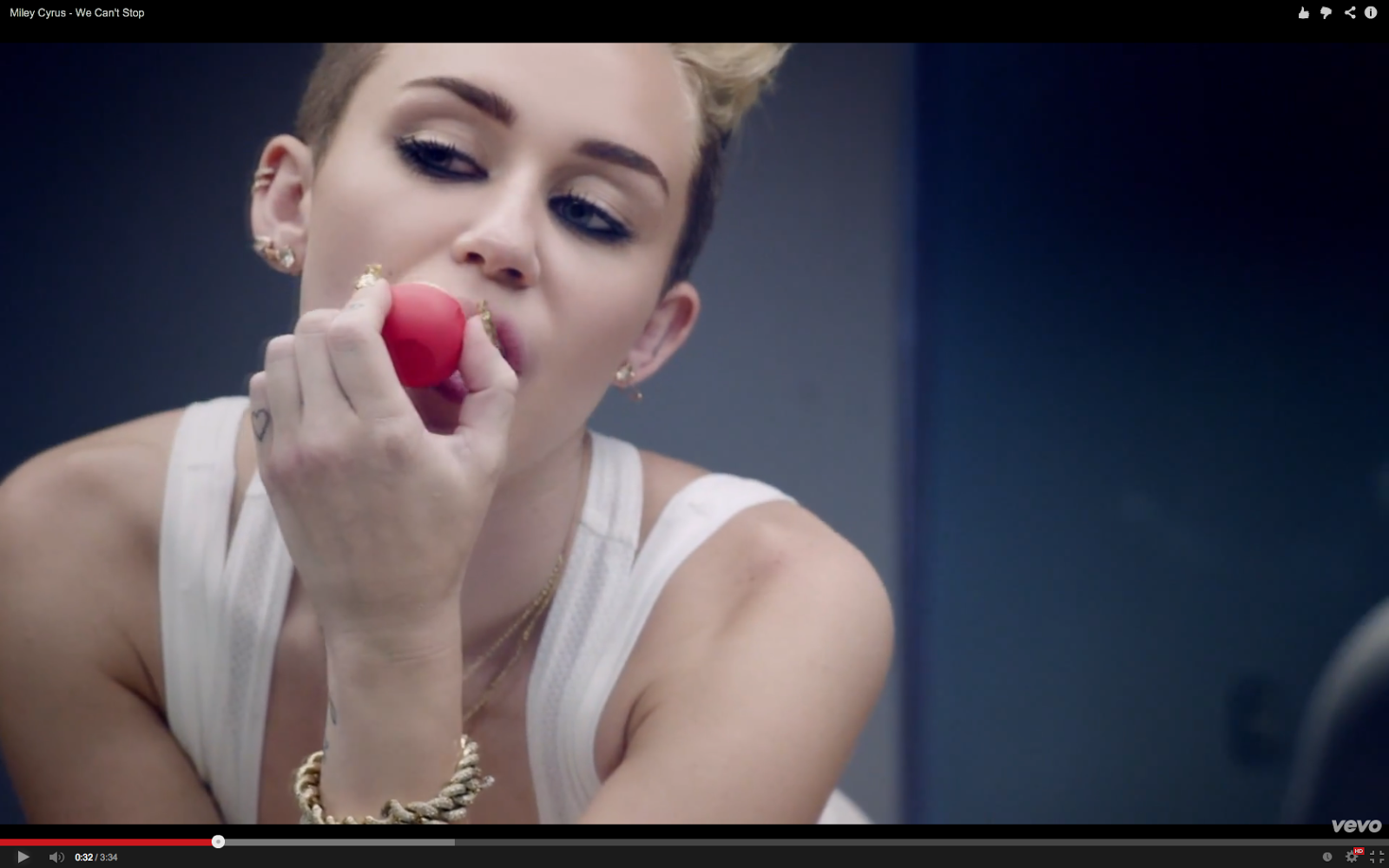
The star image of an artist is essentially their development over time and has an important part to play in the making of their music videos. Goodwin said 'the creation of character identities for stars provides a point of identification for the audience, which is especially important when lyrics lack depth.' Furthermore, the star image is the best way for an artist to reinforce their new persona, which is often shown through close ups. Here are few examples from her most recent music videos:
Miley Cyrus is an excellent example of this. Although there are more notable artists that you could research for this, such as Madonna, George Michael and Christina Aguilera, Miley Cyrus is going through her change in star image now, so it is more current with my research.
Miley Cyrus was born on 23rd November 1992. Although having a famous father, she rose to fame with her leading role in hit Disney show 'Hannah Montana'. As a result of the success from the show, Miley released an album 'Hannah Montana 2:Meet Miley Cyrus' which became the soundtrack for that series. Due to the response of the album, Miley released her second album 'Breakout'. She then starred in 'Hannah Montana: The Movie' and sung the movie soundtrack 'The Climb'.
Putting 'Hannah Montana' behind her, Miley starred in 'The Last Song' alongside Liam Hemsworth (who unbeknownst to her would become her real life fiancee). This film role emphasised Miley's more mature character as the film was one of Nicholas Sparks', a man known for emotional story lines. Miley's next album to be released was 'Can't Be Tamed' which again, showed a change in her character, and gave fans a sense of her growing up, seen through some sexually themed performances.
After taking a couple of years out to focus on her acting carer, Miley came back to the music industry with a bang, releasing 'We Can't Stop' from her fourth album 'Bangerz'. 'We Can't Stop' and 'Wrecking Ball' were promoted through provocative music videos. Moreover, Miley performed a controversial performance of 'We Can't top' alongside Robin Thicke at the 2013 MTV Music Video Awards.
Not only did her music style change, but Miley drastically changed her image. In 2012, she cut her famously long hair and dyed it blonde. Shortly after, in 2013, Miley hired Larry Rudolph as her manager, and left Hollywood Records before signing with RCA Records. The video for 'We Can't Stop' shows Miley in a more sexual way, which led to mixed responses from the public. 'Wrecking Ball' was the second single to be released from 'Bangerz' and once again, featured a sexualised music video in which Miley was wearing little clothing.
This change in appearance, music videos and music style, could be see as Miley's attempt to break away from the Disney star of 'Hannah Montana' that people constantly associated her with. Personally, although much of what she is doing is highly sexualised and creating an uproar across the world, I think it is brilliant what she is doing. She is a 20 year singer recreating herself in the spotlight, what's not to love? She is not the first and will certainly not be the last artist to drastically change their image and cause a controversial response. If anything, all the controversy has made her more famous than she was before.
Here is a mood board I created, showing the different looks Miley has sustained over the years, and to emphasise how much she has grown up and changed:




 '
'

 This screenshot shows Rihanna in the video dressed up to resemble Slash. Below is the original look worn by Slash himself. Moreover, the guitar is part of the iconography which was another of Goodwin's theories, as it represents the idea of a Rock star. Moreover, it could be argued that Rihanna's tendency to wear little clothing is part of her iconography as an artist.


 What's more, this shot from another early single 'Pon De Replay' draws attention to the fact that Rihanna has always worn little clothing in her music videos, which proves the comment that it is part of her iconography as a female artist in the industry.